
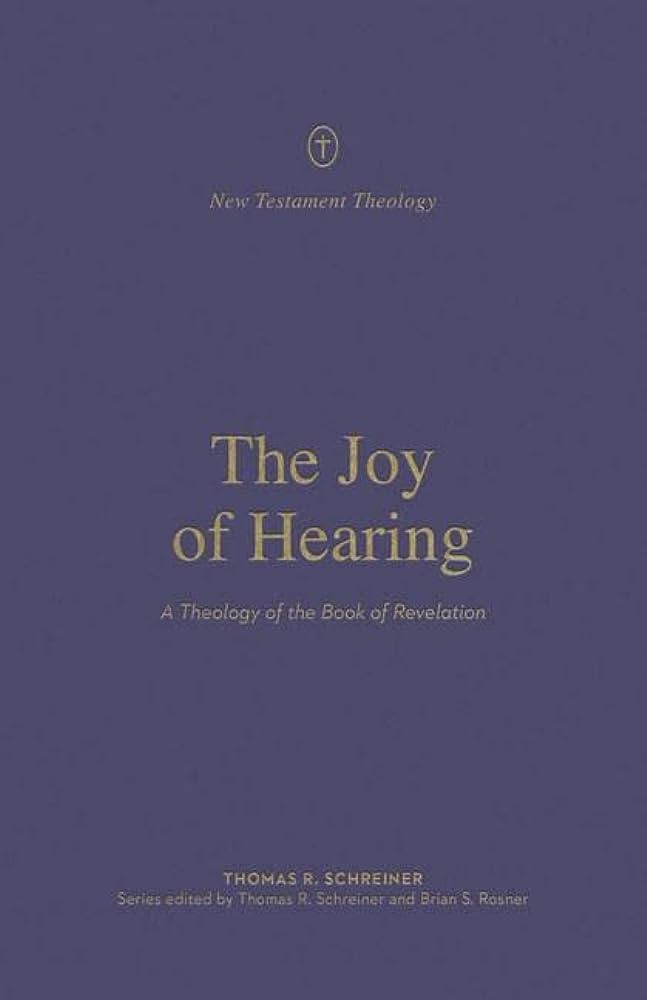
Purchase a copy of The Joy of Hearing here.
Thomas R. Schreiner is the James Buchanan Harrison Professor of New Testament Interpretation and associate dean of the School of Theology at the Southern Baptist Theological Seminary. Follow Dr. Schreiner on Twitter here. Having written commentaries on many New Testament books and written extensively on New Testament theology, Schreiner is well-qualified to tackle the major theological themes in Revelation. Furthermore, he proves competent in handling textual, linguistic, and historical details, uniting textual details with recurring big-picture themes to provide a comprehensive analysis of the theology of Revelation.
The main point of the book is that believers should hear and heed the apocalyptic message of Revelation, because God through John provides the heavenly perspective of world history; God, not Satan, is ultimately sovereign over all, and he has victoriously conquered all his enemies for his people through the Lamb that was slain. Schreiner emphasizes throughout the book that Jesus Christ himself is the central figure in Revelation. He points out the remarkably high Christology of John in Revelation as being one of the highest in the entire New Testament (111). Unsurprisingly, then, John’s main purpose in Revelation was to encourage faithfulness to Christ and endurance in persecution, not fruitless speculation and date-setting (18). Especially in the first chapter, Schreiner teaches that Revelation provides a heavenly outlook of life on earth. It may look as though God favored earth dwellers and Babylon because of their seeming prosperity, but God discloses through John his complete rejection of those who have thrown their lot in with the Beast (32-38). In contrast, believers have not compromised their faith despite how easy it would be to succumb to temptation, and they are exhorted to continue in their allegiance to Christ. Those who persevere to the end, who do not link arms with the Beast against God’s people, will receive eschatological reward and blessing (47-66). Only those who conquer and overcome will be rewarded on the last day. Naturally, this leads Schreiner to appropriately emphasize that, against easy believism, the New Testament does in fact teach the “necessity of good works for final salvation” (60,65). Indeed, it is “a regular theme” (65).
Another major theme in Schreiner’s book is the sovereignty of God. For Schreiner, God is completely and unapologetically sovereign over all world history. This is the central message of chapter 3. God’s total control of all things extends even to the evil actions performed by Satan, the beast, and the earth dwellers (68). God permits evil to be done for his own holy and wise purposes, and he also powerfully turns evil for good for his own glory and for the good of his people (69). Divine sovereignty and its relationship to evil are not theologically or philosophically hashed out by John, but God clearly reigns sovereignly on his throne without himself being responsible for doing evil (70). Schreiner wisely discussed God’s sovereignty prior to his treatment of the many judgments in Revelation as if to reinforce the reality that God is still entirely in charge when disaster and chaos mark life on earth. God is just in the seemingly unjust judgments that he pours out over the earth, because the earth dwellers have rebelled against their Creator and have taken sides with the Beast.
As hinted at earlier, the person and work of Jesus Christ is dealt with extensively. Jesus is both the Lion and the Lamb, the eternal Son of God from the tribe of Judah who died a substitutionary death for his people as a Lamb and rose from the dead as a conquering Lion. Jesus is identified with God in Revelation even as he shares in God’s essential being (104). He shares in all the glory of God and as such is to be worshipped just as the Father is worshipped (108). Believers are set apart by their union to Jesus as ones who are sealed and have washed their robes in the Lamb’s blood (128-9). Jesus in his second coming will judge the wicked and vindicate the righteous (139). The coming new creation is a “transformed city, a new and purified Jerusalem” that will be enjoyed by those who hear and obey the Spirit’s testimony (159). Finally, Schreiner tackles the great millennium debate in some detail, laying out the strengths and weaknesses of each position (161-178).
Being one who considers Schreiner one of the best contemporary Christian authors, this readers reaction to the work was overwhelmingly positive. Schreiner does an outstanding job of providing readers with a comprehensive theological analysis of the major themes in the book of Revelation. It is common to find verse-by-verse commentaries of Revelation or books that deal exclusively with the nature of the second coming, but Schreiner uniquely offers a balanced approach that gives readers an insight into what Revelation stands for as a 1st century apocalyptic and prophetic letter. Schreiner’s work could scarcely be recommended more by this reader for anyone seeking to understand the main point and thematic emphases of Revelation. Schreiner’s work also strikes a wonderful balance, as readers more interested in the exegetical and historical technicalities of Revelation will not go unsatisfied. He included certain “excursus” dealing with more complex studies in Revelation that were set apart as optional reading (82-88;122-128). This reader appreciated that addition as it provides the reader with the option to skip or read it depending on whether the reader is interested in more technical theological discussion.
One of the greatest strengths of the book is that, unlike many other works on Revelation, Schreiner does not overload the reader with all the controversies and debates surrounding various parts in Revelation. He avoids getting lost in endless speculation and theorizing about the meanings of controversial verses and chapters. Instead, he clearly, concisely, and humbly answers controversial text with strong exegetical and historical scholarship. Throughout, he keeps his readers focused on main ideas which prove to strengthen and encourage believers such as the emphasis on worshipping God and Christ and the necessity for perseverance in the face of persecution.
Schreiner states in the preface his intention to write “a short book on the theology of the book of Revelation” and upon finishing the work (and even before) it was evident that he accomplished his purpose (13). Schreiner brings with him certain hermeneutical presuppositions, such as the inspiration, inerrancy, and perspicuity of Scripture. This allows him to make strong arguments built on a rock-solid exegetical foundation. While Schreiner is reformed in many areas of his theology, he does not filter the meaning of a text through any theological tradition; he only strives for fidelity to the text itself, which the careful reader can easily discern.
It is also worth noting that the book is free of any sort of denominational dogma. Although Schreiner is Baptist, he does not employ the Baptist tradition as a final authority for doctrinal matters throughout the book. Instead, his final, decisive authority is Scripture alone. Schreiner’s arguments are shaped based on exegetical, linguistic, historical, and logical foundations. This too serves as another great strength of the book, since it is welcoming to believers from all Christian denominations who hold to a high view of Scripture, not just Baptist. The reader can discern a spirit of humility and, in a sense, inclusivity in Schreiner’s non-dogmatic approach to tier-two issues, such as the millennium debate. Schreiner fairly and accurately represents the three main millennium positions, waiting until the end to address his own view. It is also notable that, while Schreiner leans premillennial, he wisely avoids absolute dogmatism, which allows readers of different eschatological views to engage with the book. There is no noticeable eschatological bias present in the book, making it accessible to readers from different theological backgrounds.
Overall, Schreiner’s book is immensely accessible and surprising digestible for a book that is often clouded in confusion and controversy. It is one of those rare works that seem to perfectly strike the balance between academic and accessible, making it invaluable for laypeople and theologians alike.
Landon Jones is a student at Southwestern Baptist Theological Seminary. He is a member of The Paradox Church in Fort Worth. Follow him on Instagram @_landonjones_.
 The King’s Table